
The Difference Between Capturing Motion and Capturing Performance
Motion capture technology has improved dramatically over the years. Cameras are more accurate, software is more capable, production pipelines are more sophisticated, and new solutions continue to emerge—from optical systems and inertial suits to markerless capture and AI-assisted workflows.
Yet many of the same challenges that affected motion capture productions twenty years ago still exist today.
Why?
Because most motion capture problems are not technical problems.
They're planning problems. Communication problems. Performance problems.
After decades working in animation, cinematics, and motion capture, I've found that the most successful sessions are rarely the ones with the most advanced technology. They're the sessions where the goals are clear, the action is understood, the actors know what they're playing, and the entire team is focused on performance rather than simply recording movement.
Technology continues to evolve.
Believable performance still depends on the same fundamentals it always has: preparation, direction, communication, and trust between performers and the team supporting them.
The tools have changed.
The fundamentals have not.
1. Reference Is Not Optional
One of the biggest mistakes in motion capture happens before anyone ever steps onto the stage.
Reference is often treated as something that can be gathered later or figured out during production. In reality, strong reference should help drive many of the creative and technical decisions made before recording begins.
Good reference creates alignment. It establishes a shared understanding of performance, tone, physicality, gameplay requirements, and creative intent. It gives actors, animators, designers, and directors a common vision to work from.
Without that alignment, people begin solving different problems. Actors interpret scenes differently. Animators focus on the wrong details. Designers prioritize different goals than the performance team. The result is confusion, inconsistency, and unnecessary rework.
Reference is more than inspiration.
It is a communication tool.
Strong sessions start with a shared visual language, and reference helps create that language before the cameras ever start recording.
2. Define Performance Before Recording
Production teams often spend countless hours discussing schedules, equipment, shot counts, and technical requirements. Far less time is spent defining the performance itself.
Before a scene is captured, everyone should understand what the character wants, what obstacles stand in their way, what emotional state they're experiencing, and what story information must be communicated to the player.
Actors need time to absorb the material and understand why the scene matters. Knowing the lines and blocking isn't enough. Strong performances happen when performers understand the character's objectives, relationships, and emotional journey.
Performance direction begins long before the cameras start rolling. It begins with clarity.
Technology can capture movement with remarkable accuracy.
It cannot create dramatic intent.
That responsibility belongs to the creative team.
3. Give Actors Something To Play
Motion capture records human performance. It does not generate it.
Actors need more than dialogue and blocking. They need context, relationships, objectives, motivation, atmosphere when possible, and meaningful stakes.
When performers understand who they are, who they're talking to, what they want, and why the moment matters, they stop executing actions and begin making choices. Those choices create believable behavior, and believable behavior creates memorable characters.
The same principle applies to AI-assisted workflows. Technology can generate movement, but it cannot automatically generate intent, emotional truth, or an understanding of how a performance supports the final player experience.
Performance comes first.
Everything else supports it.
4. Understand the Entire Pipeline — Including the Game
A successful motion capture session is not measured by what happens inside the capture volume. It is measured by what survives all the way to the final player experience.
Performance can be lost during cleanup, retargeting, animation polish, gameplay integration, camera changes, cinematic implementation, and engine constraints.
One of the most valuable skills a performance director can develop is understanding what happens after the shoot.
Animators need usable data. Gameplay systems require readability and responsiveness. Technical limitations often force compromises. A performance that feels incredible on stage may become difficult to implement if it doesn't support gameplay requirements or align with the realities of the engine.
The goal isn't simply to capture a believable performance.
The goal is to capture a believable performance that survives the entire pipeline, supports the needs of the game, and still connects with the player.
5. Capture Performance, Not Just Motion
Many motion capture challenges can be traced back to a single issue.
Teams naturally focus on marker quality, tracking accuracy, frame counts, and data integrity. All of those things matter.
But players never remember marker quality.
They remember characters.
They remember relationships.
They remember moments.
They remember performances.
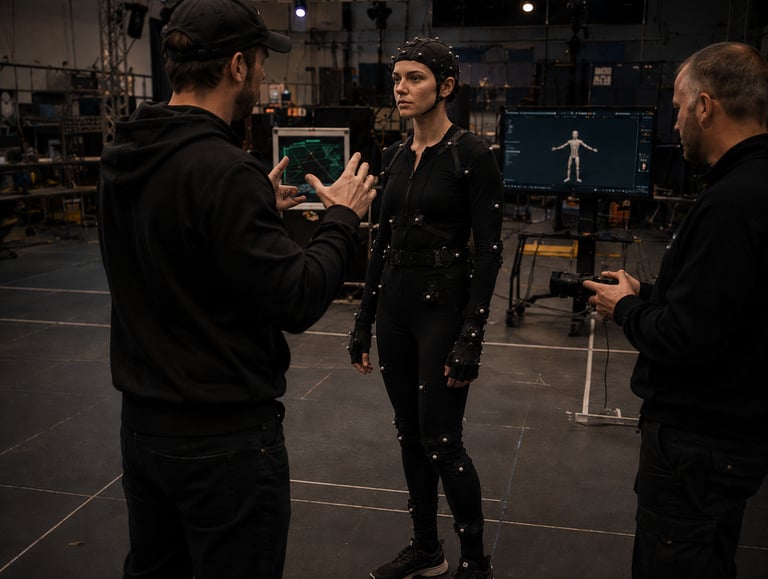
One of the most overlooked aspects of motion capture is the environment we create for performers. Actors are often asked to imagine worlds that don't exist yet, characters that haven't been built, and situations that only live on storyboards, animatics, and concept art.
The more we help actors understand the world, the relationships, the stakes, and the purpose of the scene, the more believable the performance becomes.
Good direction isn't simply about telling actors where to stand. It's about creating the conditions that allow great performances to happen.
Because motion capture records movement.
Audiences remember performance.
Final Thoughts
The goal of motion capture has never been simply to collect data.
The goal is to create believable performances that remain authentic throughout the entire production pipeline.
That process begins long before recording starts and continues long after the session ends. It requires strong reference, clear intent, prepared actors, an understanding of gameplay, and a deep awareness of animation, cinematics, and technical implementation.
Technology alone does not create memorable characters.
People do.
Actors. Directors. Animators. Designers.
Every decision made throughout the pipeline either strengthens or weakens a performance.
Great motion capture isn't about recording movement. It's about capturing performances that survive the entire pipeline, support the needs of the game, and ultimately create a meaningful connection with the player.
Because players don't remember motion data.
They remember characters.
BERT FARACHE
Turning motion into believable cinematic performance.
Available
linkedin.com/in/bertfarache
(C) 2026 Bert Farache-Full-pipeline direction. Worldwide.
Performance fidelity — pipeline to screen

